

:max_bytes(150000):strip_icc():format(webp)/GettyImages-1289084524-2e1922cb4f7f431d82b59ec77b0ef19c.jpg)
The Kinsey Scale was created by pioneering sex researcher Alfred Kinsey and his colleagues Wardell Pomeroy and Clyde Martin, who called it the Heterosexual-Homosexual Rating Scale. It was first introduced in their book Sexual Behavior in the Human Male in 1948.
Although it has a number of limitations, the Kinsey Scale was groundbreaking when it was initially published because it was the first scientific scale to suggest that human sexuality and sexual attraction are a continuum and not limited to solely heterosexual or homosexual orientations.
This article discusses the origins of the Kinsey scale, what the scale tells you, and how it works. It also explains the limitations of the scale and its impact on the study of human sexual orientation.
Origins of the Kinsey Scale
Kinsey, a biologist, and his team studied human sexual behavior, preferences, thoughts, and feelings by interviewing thousands of people, with Kinsey alone conducting 8,000 interviews.1
Kinsey found that 37% of the men he interviewed had a same-sex experience sometime between adolescence and old age, a rate that jumped to 50% for unmarried men by the age of 35.2
Meanwhile, of the women he interviewed, 13% had a same-sex experience.3 This research made it clear that human sexuality couldn’t be defined as exclusively heterosexual, homosexual, or bisexual.
How the Kinsey Scale Works
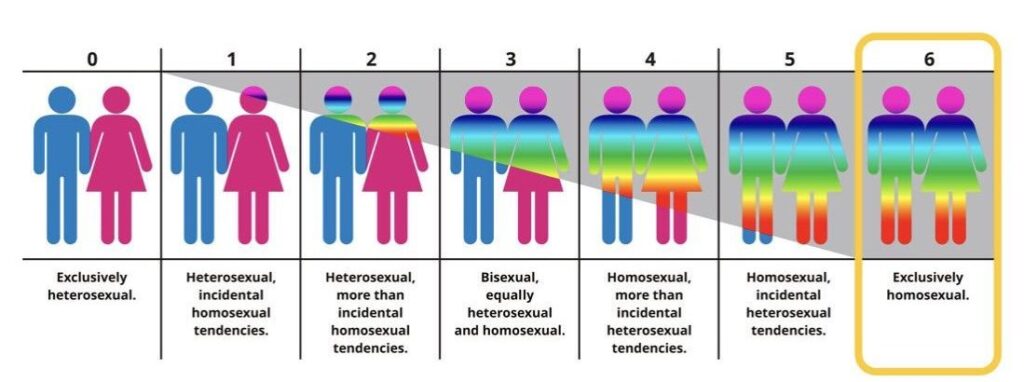
The Kinsey Scale ranges from 0 to 6 and includes an additional category labeled “X.” Here are the various ratings and their definitions:
- 0: Exclusively opposite sex/heterosexual behavior or attraction
- 1: Predominantly heterosexual, but slightly inclined to be attracted to the same sex or engage in homosexual behavior
- 2: Predominantly heterosexual, but more than slightly inclined to be attracted to the same sex or engage in homosexual behavior
- 3: Equally heterosexual and homosexual behavior or attraction
- 4: Predominantly homosexual, but more than slightly inclined to be attracted to the opposite sex or engage in heterosexual behavior
- 5: Predominantly homosexual, but slightly inclined to be attracted to the opposite sex or engage in heterosexual behavior
- 6: Exclusively same-sex/homosexual behavior or attraction
- X: No socio-sexual contacts or reaction/asexual
Kinsey and his colleagues used the scale to categorize the individuals they interviewed. Consequently, no official Kinsey “test” exists to go with the scale, even though such tests have been created by others and many can be found online.
Limitations of the Kinsey Scale
While the Kinsey Scale changed perceptions of human sexuality, it didn’t fully capture the complexity and nuance of sexual behavior and attraction. Based on current understandings of sexuality, the scale is limited by the following listed below.
It Doesn’t Account for All Sexualities
The entirety of human sexuality isn’t encompassed by the Scale’s heterosexual, homosexual, bisexual, and asexual categories. Today, people identify as pansexual, demisexual, and many other orientations that make up a rich tapestry of sexual behavior and attraction.
It Assumes Heterosexuality and Homosexuality Are Opposites
The Kinsey Scale is structured so that homosexuality and heterosexuality are inversely related. Thus, according to the Scale, the more someone identifies as heterosexual, the less they identify as homosexual and vice versa.
However, studies show opposite-sex and same-sex attraction are not related to one another but are experienced separately. As a result, homosexuality, bisexuality, and heterosexuality should be considered independent constructs.4
It Conflates Sexual Behavior and Attraction
The Scale categorizes people based on sexual behavior and attraction, but these are two different things that often don’t correspond.5
For example, a man might be attracted to both men and women but only engage in sexual behavior with women.
Moreover, the Scale doesn’t account for a third category: sexual identity, or the label an individual uses for their sexual orientation. For instance, the man in the above example may refer to himself as heterosexual, even though he clearly experiences some homosexual attraction.
Ultimately, his sexual behavior, attraction, and identity don’t match up and therefore can’t be accurately captured by the categories on the Kinsey Scale.
It Assumes Gender Is Binary
The Scale also works off the assumption that people identify as either men or women, while completely overlooking the existence of trans, intersex, or other gender identities, further limiting who the Scale can be applied to.